
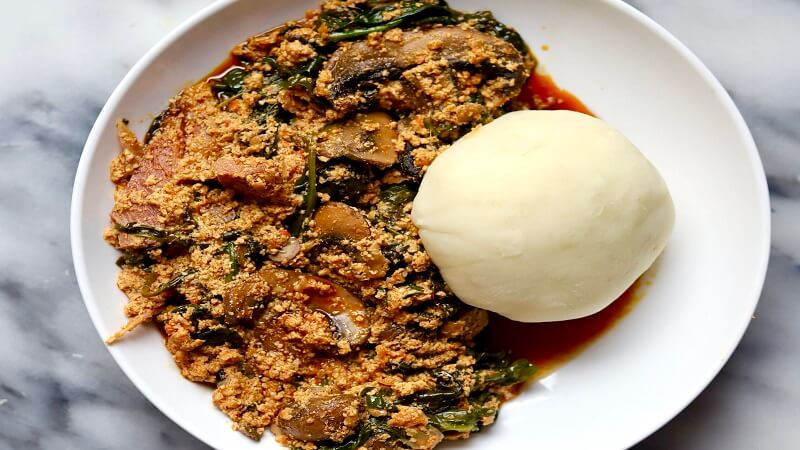
Ask any Nigerian what they want with pounded yam and you will get an answer before you finish the question. Egusi. Efo riro. Ogbono. Okra. Oha. Everybody has a favourite, and everybody has an opinion about how it should be made. What nobody argues about is the swallow itself: a smooth, stretchy ball of pounded yam is the plate that makes a soup feel like a proper meal.
The problem, for most of us living outside Nigeria, has never been the soup. It has been the yam. Boiling tubers, pounding them in a mortar, keeping the texture right while your arms give out. That is a Sunday job, and most weeks do not have a Sunday to spare. So the soup gets made and eaten with rice, or with garri, and pounded yam becomes a special-occasion food.
It does not have to be. Good pounded yam flour made from nothing but yam takes about two minutes with a kettle and a wooden spoon, and it tastes like the real thing because it is the real thing, just dried and milled ahead of time. Once the swallow is quick, the only question left is which soup to cook, and how to cook it without spending the whole evening at the stove.
Here are five soups that belong with pounded yam, with the shortcuts that actually work.
1. Egusi soup
Egusi is the one most people picture first. Ground melon seeds, palm oil, pepper, leafy greens and assorted meat come together into a thick, nutty soup that clings to pounded yam in a way nothing else does. There is a reason it is on every party menu and in every buka.
The traditional method is slow because of the meat. Goat, beef, shaki, ponmo and stockfish each need their own cooking time, and most recipes have you boil them one after another. The soup itself is quick once the stock is ready.
How to cook it faster: Make the meat stock in bulk on a day you have time, portion it, and freeze it. With a container of assorted-meat stock already in the freezer, egusi becomes a thirty-minute soup. Fry the ground egusi in palm oil with blended pepper and onion, let it curdle into little clumps, pour in the stock, add crayfish and seasoning, and finish with ugu or spinach. Done.
A second shortcut: fry a double batch of the egusi base and freeze half before adding the greens. Next time, you only need to reheat and add vegetables.
2. Efo riro
Efo riro is a Yoruba vegetable stew, and if you have ever had it done well you know it is not a “side” vegetable at all. It is rich, peppery and full of smoked fish, with the greens cooked just enough to soften and no further. The palm oil and pepper base is what makes it, and the vegetables are almost a garnish for the sauce.
Because the greens cook in minutes, efo riro is naturally one of the faster soups. The slow part is the pepper mix, which many cooks blend fresh each time, and the smoked fish, which needs cleaning and flaking.
How to cook it faster: Blend a big batch of your pepper base, which is usually red bell pepper, scotch bonnet, tomato and onion, cook it down with a little oil until the water has gone, and keep it in the fridge or freezer in small portions. This “ata” base is the backbone of efo riro, and of half of Nigerian cooking. When it is ready in advance, efo riro is a twenty-minute dish. Clean and flake your smoked fish on the same prep day. Frozen chopped spinach is a perfectly good stand-in for fresh greens on a weeknight.
3. Ogbono soup
Ogbono, made from ground bush mango seeds, is a “draw” soup. It has that slippery, stretchy texture that some people love and some people need a minute to get used to. With pounded yam it is close to perfect, because the soup and the swallow have a similar slippery quality and go down together.
The cooking is not long, but ogbono is easy to get wrong. Add the ground seed to oil that is too hot and it clumps. Boil it too hard and it loses its draw.
How to cook it faster, and better: Dissolve the ground ogbono in warm palm oil off the heat first, stirring until it is a smooth paste with no lumps. Then add warm stock slowly while stirring. Keep the heat medium, never a rolling boil. Because the technique is the whole job, ogbono is actually ideal for a weeknight once you have the stock ready: it comes together in about twenty-five minutes. Add okra if you like a thicker, greener version.
4. Okra soup
Okra soup is the one to cook when you have almost no time and still want something that feels like home. Fresh okra, chopped or grated, cooks in minutes. Add pepper, palm oil, crayfish, a little smoked fish or shrimp, and you have a light, bright soup that works beautifully with pounded yam on a warm evening.
It is already fast, so the trick here is less about speed and more about not overcooking it. Okra that has boiled too long goes dull and loses its freshness.
How to cook it faster: Grate the okra in a food processor rather than chopping by hand, and add it at the very end. Three to five minutes in the pot is enough. If you want more body, stir a spoon of ground egusi into the oil before adding the okra. Frozen chopped okra works well and saves prep.
5. Oha soup
Oha, or ora, is an Igbo soup built on tender oha leaves and thickened with cocoyam, achi or ofo. It has a gentler, more delicate flavour than egusi or efo riro, and it is traditionally a soup for special gatherings, partly because of the thickener. Boiling and pounding cocoyam is almost as much work as pounding yam itself.
How to cook it faster: Use a dried thickener such as achi or ofo instead of fresh cocoyam. A couple of spoons stirred into warm stock does the job in minutes with no boiling or pounding. Oha leaves should be torn by hand, not cut with a knife, and added right at the end so they stay soft and green. If you cannot find fresh oha where you live, dried oha leaves are available in most African stores and online, and they rehydrate well.
The common thread: prep day
Every one of these soups gets dramatically faster if you do three things on one afternoon a week:
- Make stock in bulk. Assorted meat, stockfish and dried fish boiled with onion, seasoning and a little salt. Portion and freeze.
- Make your pepper base in bulk. Blended and cooked down, then portioned.
- Clean your dried fish and crayfish. Nobody wants to be picking bones at 7pm on a Wednesday.
With those three things in the fridge, almost any Nigerian soup is a thirty-minute job. And the swallow, which used to be the hardest part, is now the easiest. Pour hot water, add the flour, stir and fold, and you have pounded yam before the soup has finished warming through.
Matching the soup to the swallow
One thing worth saying: not every swallow suits every soup, and pounded yam is unusual in that it suits all of them. Amala has a strong, earthy flavour that pairs best with ewedu and gbegiri. Eba is neutral and goes with most things but can feel heavy with very thick soups. Pounded yam is soft, mild and slightly sweet, and it is the only swallow that most Nigerians would happily eat with any of the five soups above. If you are only going to keep one swallow in the cupboard, that is a strong argument for making it this one.
If you want a longer list of pairings, including some of the less common soups, there is a good guide to what to eat with pounded yam that covers the full range from banga to nsala.
A few practical notes for cooking abroad
If you are cooking these soups in the United States, Canada or the UK, a few substitutions make life easier without hurting the result:
- Greens: Spinach, kale and collard greens stand in well for ugu and efo in most soups. Collards are closest to ugu in texture.
- Pepper: Red bell pepper plus scotch bonnet or habanero gives you the colour and heat of tatashe and ata rodo.
- Meat: Oxtail, beef shin and goat from a halal or Caribbean butcher are usually the best value for stock.
- Dried fish and crayfish: These are the ingredients that are genuinely hard to replace. Buy them from an African grocer, and buy enough to last, because they keep well in the freezer.
None of this is about compromising. It is about making these soups part of an ordinary week rather than a once-a-month event. Pounded yam used to be the reason that was difficult. Now it is the easiest part of the meal.